

Wael Taji Miller
Senior Research Fellow
Oct 20, 2026
Introduction: AI and techno-economic paradigms
Now that the world has recognized the fact that the AI revolution is truly here, it is worth considering what exactly that term – AI revolution – really means. Sometimes, we use temporal language, referring to AI as a ‘technological epoch’. Other times, we use monetary language, describing AI as an ‘economic system’. By using such language, we miss the forest for the trees. AI cannot be described in terms that fit neatly within our conventional academic categories. When dealing with AI, we deal not only with chatbots, nor deepfakes, nor even automation; we deal with a totalizing system of agentic non-human intelligence which leaves no aspect of collective human life untouched.
And yet (perhaps paradoxically to some) there is nothing new under the sun (Ecclesiastes 1:9). Since the dawn of the Industrial Revolution 250 years ago, humanity has experienced multiple transitions that began with technological innovation, but then went on to establish their presence in the economy and in society. Carlota Perez, a Venezuelan neo-Schumpeterian economist, spent most of her life studying these phase transitions (or technological revolutions), and established taxonomies to describe them in multiple books and papers. Perez refers to the more static intervals between one technological revolution and the next as “techno-economic paradigms.”1
| Techno-economicparadigm | Popular namefor the period | Core countryor countries | Big-bang initiatingthe revolution | Year |
|---|---|---|---|---|
| FIRST | The ‘Industrial Revolution’ | Britain | Arkwright’s mill opens in Cromford | 1771 |
| SECOND | Age of Steam and Railways | Britain (then Continent, then USA) | Test of the ‘Rocket’ steam engine for the Liverpool-Manchester Railway | 1829 |
| THIRD | Age of Steel, Electricity and Heavy Engineering | USA and Germany forging ahead and overtaking Britain | The Carnegie Bessemer steel plant opens in Pittsburgh, Pennsylvania | 1875 |
| FOURTH | Age of Oil, the Automobile, and Mass Production | USA (with Germany at first vying for world leadership), later spreading to Europe | First Model-T comes out of the Ford plant in Detroit, Michigan | 1908 |
| FIFTH | Age of Information and Telecommunications | USA (spreading to Europe and Asia) | The Intel microprocessor is announced in Santa Clara, California | 1971 |
| SIXTH | Age of Artificial Intelligence | USA and China (where models are trained), diffusing globally through digital space | ChatGPT is released to the public, built on the Transformer architecture (Vaswani et al., 2017) | 2022 |
Source: rows one to five reproduced and modified from Table 2.1 in Carlota Perez (2002), p11; row six adapted from Taji (2022), p76.
A techno-economic paradigm is “a best practice model for the most effective ways of using the new technologies within and beyond the new industries.”2 Starting in 1771, Perez counts five of these paradigms, each lasting on average 50 years before the next technological revolution occurs. Assuming that pattern holds, simple arithmetic would predict that the next paradigm would begin in the 2020s, 50 years after the latest paradigm identified by Perez in 1971 (the Age of Information and Telecommunications). Some noticed the fact that we were overdue a technological revolution even before ChatGPT came around.3
Techno-economic paradigms develop in a predictable way. Once the innovation that allows for new ways of organizing production or society becomes applied, the benefits yielded result in rapid copying and recombination of the underlying innovation in new contexts and settings. This rapid copying and recombination, Harvard’s Joseph Henrich and LSE’s Michael Muthukrishna argue, is itself a form of social learning that gives technological adoption the same kind of ‘virality’ as we are accustomed to seeing in popular culture and human language.4 Eventually, once the innovation has saturated itself throughout the economy and society, a slowdown in adoption kicks in, and the growth curve begins to flatten out. In this way the phase transition is completed, and the new techno-economic paradigm becomes established.
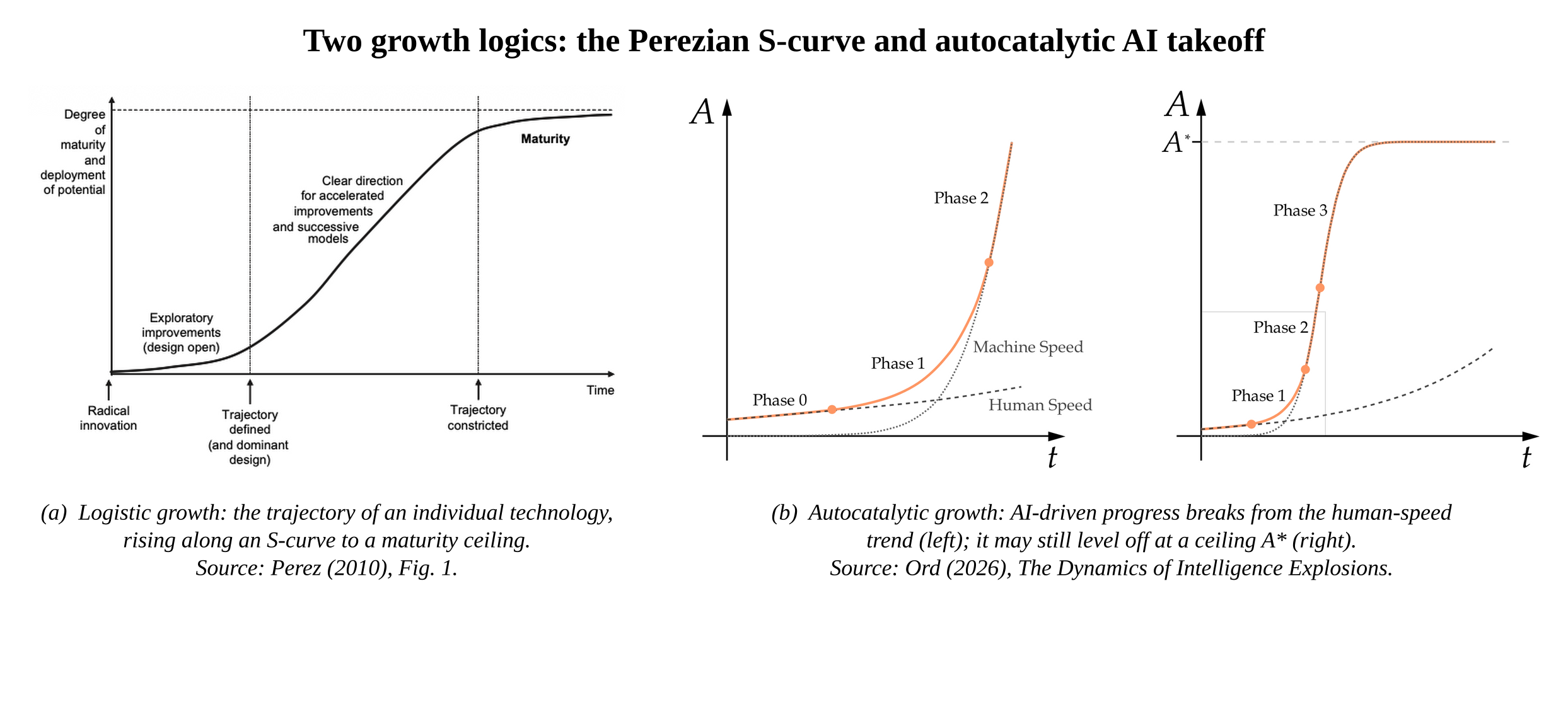
Figure 1. Two growth logics: the Perezian S-curve and autocatalytic AI takeoff. (a) In Perez’s model, an individual technology follows a logistic trajectory. After an exploratory phase, a dominant design sets the direction for rapid improvement, until diminishing returns constrict the trajectory and it levels off at maturity. (b) In Ord’s model, once AI systems begin to accelerate AI research itself, progress breaks away from the human-speed trend and follows a machine-speed curve (left panel). The right panel shows that even such a takeoff may eventually level off at a ceiling, A*, but at a height and speed far beyond the Perezian curve.5
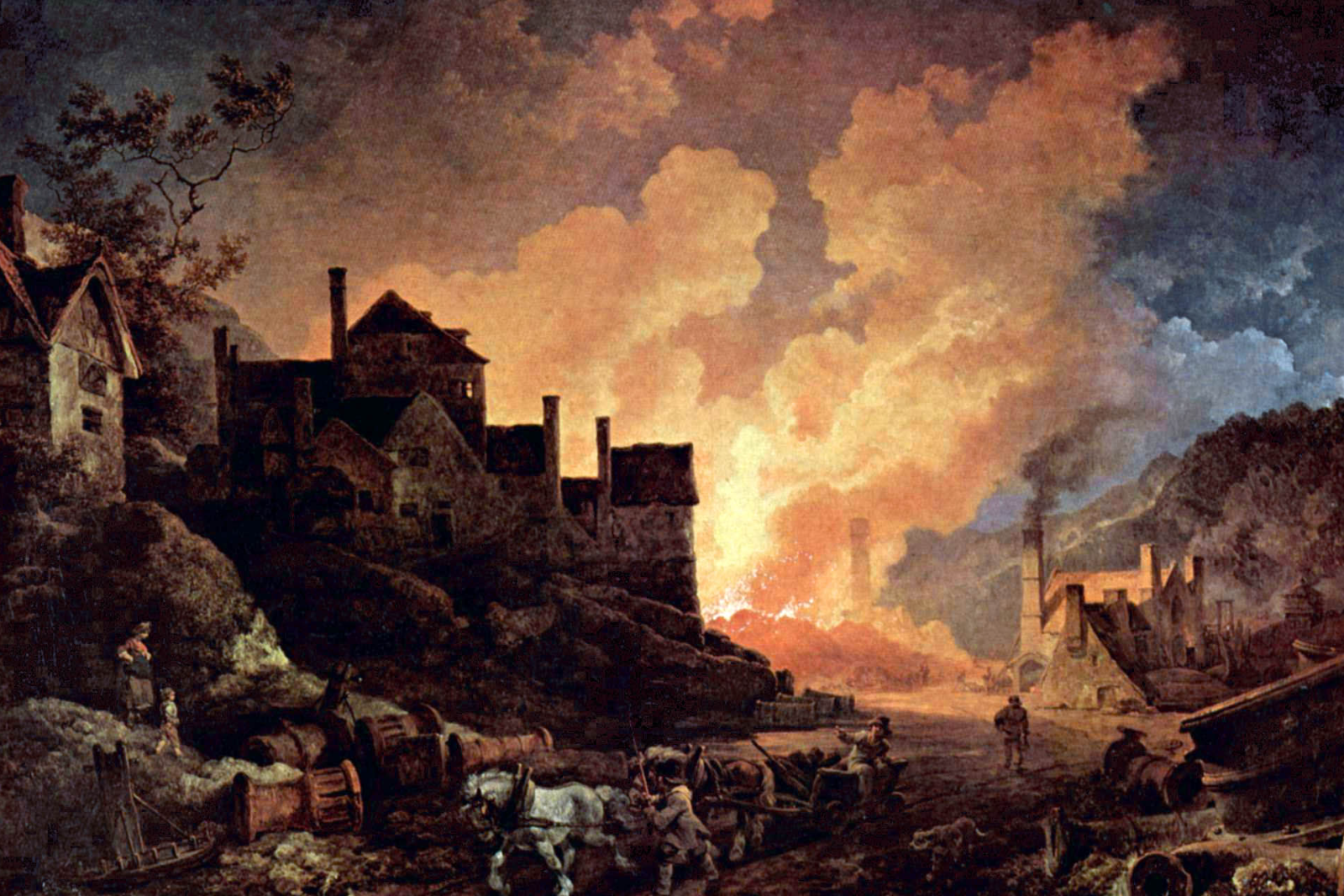
Yet there is one aspect of AI that makes it fundamentally different from other techno-economic paradigms. AI is not merely a technology that is adopted by society or the economy; it is an agent that has the capacity and the tendency for self-enhancement. Steam engines do not themselves build more steam engines or improve the existing stock of engines; AI, by contrast, not only replicates itself but also improves itself over time. In this sense, AI research and development more closely resembles a fire than it does previous technologies.
A fire is a chemical reaction that exhibits autocatalysis, consuming more and more until it burns out after physical constraints are reached and physical resources are exhausted. The qualities of the physical limitations on AI progress are knowable, since AI will invariably require physical matter and energy in order to scale indefinitely. The quantities of these limitations, however, are estimated by experts to be so extremely high as to be incompatible with the necessary conditions for human existence.6
This fact that indefinite and unobstructed AI scaling requires reconfiguring our planet and its resources in such a way that would render it uninhabitable to us humans is precisely why an increasing number of people around the world – researchers, religious leaders, politicians, and concerned citizens – are calling for an AI pause. What this means more specifically is a pause on frontier AI research and development: research of the kind that resulted in frontier agents from OpenAI breaking out into a swarm and hacking multiple companies in the cyberattacks known as the Hugging Face Incident in the Summer of 2026.7 There are yet-to-be published research papers currently in circulation which explore in depth the feasibility of an AI pause with conclusions that are encouraging, and which will surely encourage Christians and non-Christians all around the world who are concerned about the very real existential dangers associated with frontier AI development. However, it is critical to recognize that even pausing AI will not solve the structural problems in the economy or in society that have emerged as result of AI’s ascendance over the past three years.
An AI pause can prevent the technological revolution we are currently experiencing from continuing indefinitely. It cannot ’undo’ the fact that we are now living in the Age of Artificial Intelligence, and that this will continue to be our techno-economic paradigm in the foreseeable future. The question as to how we learn to live with AI, and how we can control it rather than allowing it to control us, remains on the table.
Techno-Economic Paradigms and the Social Contract
Every techno-economic paradigm in history has involved a negotiated settlement within societies about who gets what, and who does what, in the new system. Well before the Industrial Revolution, in what Stability AI co-founder Emad Mostaque refers to as the “age of Land Dominance,”8 society was governed by a complex web of rights and obligations within hierarchical structures that decided who did what, and what they received in exchange, in relation to the means (both material technology and cultural technology) available to them at the time.
The prototypical example of this is the feudal system: the sociopolitical and economic machine of Medieval Europe, out of which the modern West would eventually spring. Feudalism was organized around the three classes or estates of the Middle Ages: the clergy, the nobility, and the peasantry (those who pray, those who fight, and those who work). The peasants were obliged to work the fields, and in return received education and communal religious services from the clergy, and protection from the nobility. The clergy were obliged to provide religious instruction and services, and in return received their means of subsistence from the peasants and protection from the nobility. The nobility were obliged to fight, and in return received legitimacy and religious support from the clergy, as well as taxation from the peasantry.
This arrangement was far from just by modern standards, and it was also liable to abuse. The feudal system was constantly struck by intra-elite conflicts among the nobility, disputes and infighting among the clergy (leading to multiple religious schisms and attempts at reformation) and peasant rebellions from the feudal serf class. Even so, it was coherent. All classes within society had a shared understanding of rights and responsibilities, which were tied to the underlying means of production and the superjacent political authority.
Over time, incremental advances in material and cultural technology, as well as major geopolitical events like the Protestant Reformation and the discovery of the New World would weaken the Feudal consensus. Eventually, the advent of the Industrial Revolution began a process which would fundamentally break whatever vestiges of this system were still left.
In Perezian theory, every system requires a certain set of mutual understandings (a collective consensus) in order to function and sustain itself (see Alasdair MacIntyre’s After Virtue). Under Feudalism, as we have shown, examples of this are readily found. For instance, the peasants had certain rights, but also certain obligations, which complemented and were balanced by the rights and responsibilities afforded to other classes. A transition from one techno-economic paradigm to another brings greater functional capabilities to the system as a whole (as new technologies cause things which were previously unfeasible to become both possible and profitable) but this expansion of economic productivity and power necessitates an eventual renegotiation of rights and responsibilities between the different constituents that make up society. In other words, the new techno-economic paradigm eventually finds itself in need of a new social contract to adjust to the new conditions, material and societal alike.
The launch point for the Industrial Revolution was the 1770s, and by 1850, it was in full swing. The new social contract was reconfigured incrementally; it moved forward at a substantially different pace in different societies and cultures. By 1833, Britain had passed the Factory Act, preventing children under 9 from working. In Central and Eastern Europe, change was slower; Hungary was only able to ban the feudal system and serfdom in 1848, by which time the English and American working classes had enjoyed full freedom of movement and labor for over a hundred years. In 1889, as many German industrial workers were aging into obsolescence, the great statesman Otto von Bismarck saw the signs and created the world’s first public pension system for civilians to address the problem. Only toward the end of the 19th century had the social contract more or less caught up with the new paradigm across the European continent.
In the interim, before the technological and economic changes were worked out at the level of rights and responsibilities, there was chaos. Socialist and Anarchist revolutionaries, driven by ideologues like Karl Marx and Mikhail Bakunin, threatened the integrity of industrialized powers in both Europe and the Americas. Such ideologues have always existed, and still exist now. More often than not, these ideologues become popular because they are correct (at least directionally) in their diagnosis of the problem, although they are almost never sincere or altruistic in their proposed solutions.
What eventually stabilized the system was the post-industrial social contract – a package of rights and responsibilities that typically included workers’ rights, pension systems, the freedoms of the press, and in most Western countries, the extension of voting rights. The last of these was particularly significant; in early 1800s England, only 3% of the total population had the right to vote. By the end of the century, over 60% of adult men had the right to vote, meaning that most households across the country could now participate in democracy directly. This new social contract was not set in stone; it was flexible, and constantly under scrutiny from its own stakeholders. But it could evolve to accommodate the disruptive impacts of technological change without needing to be broken apart and rewritten entirely.
In the early 20th century, when mass factory production and Henry Ford-style assembly lines began to spread, women were recruited en masse to participate in manufacturing work – particularly during World War I. As a direct consequence, this period, identified by Perez as the ‘Age of Oil, the Automobile, and Mass Production,’ saw one of the fastest expansions of the franchise in history. Finland (1906), Norway (1913) and Denmark (1915) led the way, and in the war’s immediate aftermath Britain, Germany, Austria and Poland (1918), the Netherlands and Sweden (1919), and the United States (1920) followed. In Hungary, women voted for the first time in 1920, sending Margit Slachta, a Catholic religious sister, to parliament as its first female member.
In 1890, an article authored by Samuel Warren and (future supreme court justice) Louis Brandeis entitled The Right to Privacy appeared in the Harvard Law Review. One of the most influential legal essays in American history, the article advocated overtly for the establishment of a new right that was not explicitly present in American law at that time. Its rationale is given in the opening preamble as follows:
“THAT the individual shall have full protection in person and in property is a principle as old as the common law; but it has been found necessary from time to time to define anew the exact nature and extent of such protection. Political, social, and economic changes entail the recognition of new rights, and the common law, in its eternal youth, grows to meet the demands of society.”9
Warren and Brandeis recognized that their new technological era had necessitated a reconfiguration of the social contract. But they were not alone. One year later in 1891, Pope Leo XIII issued the Papal Encyclical Rerum Novarum. Focusing on “Rights and Duties of Capital and Labor,” Pope Leo XIII’s encyclical explicitly advocated a renegotiated settlement of the social contract during the late industrial period to preserve human dignity and the common good in the face of profound challenges brought about by the contemporary techno-economic paradigm.
Clearly, this has been done before, and it can be done again. The key difference between our present situation and that of the late 19th century is that time is a luxury we can no longer afford. We must have the boldness and strength of conviction to look at the world around us and accept the transformative impact of the AI Revolution for what it truly is. It is only when we have done so – when we have completed our journey through the stages of grief and accept that we are dealing with an existential challenge – that we can begin to propose genuine solutions.
Of course, it is that stage of engaging with the problem (solving it) that will prove to be the hardest, and likely also the most painful. In Part II of this series, we will explore the possibilities for new rights, and also new responsibilities, in the Age of AI.
References and Endnotes
- Perez, C. (2010). Technological revolutions and techno-economic paradigms. Cambridge Journal of Economics, 34(1), 185–202. https://doi.org/10.1093/cje/bep051
- Carlota Perez, Technological Revolutions and Financial Capital: The Dynamics of Bubbles and Golden Ages (Cheltenham: Edward Elgar, 2002). P189.
- Taji, W. (2022). Stable Diffusion and the pitfalls of innovation: How our creativity might kill itself. Hungarian Conservative, 2(6), 74–83.
- Muthukrishna, M., & Henrich, J. (2016). Innovation in the collective brain. Philosophical Transactions of the Royal Society B: Biological Sciences, 371(1690), Article 20150192. https://doi.org/10.1098/rstb.2015.0192
- Sources: (a) Perez, C. (2010). Technological revolutions and techno-economic paradigms. Cambridge Journal of Economics, 34(1), 185–202, Fig. 1. (b) Ord, T. (2026, August 29). The dynamics of intelligence explosions. ForeWord. https://newsletter.forethought.org/p/the-dynamics-of-intelligence-explosions
- Davidson, T., Hadshar, R., MacAskill, W. (2025). How Far Can AI Progress Before Hitting Effective Physical Limits?. [online] Available at: https://www.forethought.org/research/how-far-can-ai-progress-before-hitting-effective-physical-limits [Accessed 15 Oct. 2026]
- METR. (2026, August 26). Brief independent investigation of agents’ behavior, reasoning and collaboration in the OpenAI / Hugging Face hacking incident. https://metr.org/blog/2026-08-26-openai-hugging-face-incident-investigation/
- Mostaque, E. (2025). The last economy: A guide to the age of intelligent economics. Intelligent Internet. P8.
- Warren, Samuel; Brandeis, Louis (December 15, 1890). "The Right to Privacy" . Harvard Law Review. IV (5): 193–220 – via Wikisource.
Wael Taji Miller
Senior Research Fellow
Wael Taji Miller is a cognitive scientist and researcher with over a decade of policy and consulting experience, and an active member of an international AI research group led by Hungary’s foremost Catholic university. Wael’s academic research focus lies in the nexus where technology and human biology collide; within this theme, he has published multiple peer reviewed papers in Q1
Recent Articles



Categories
AI & Faith
Announcements
Commentary
Culture
From the Field
News
Our Work
Perspectives
Policy
Updates
Workshops