
Wael Taji Miller
Senior Research Fellow
Oct 24, 2026
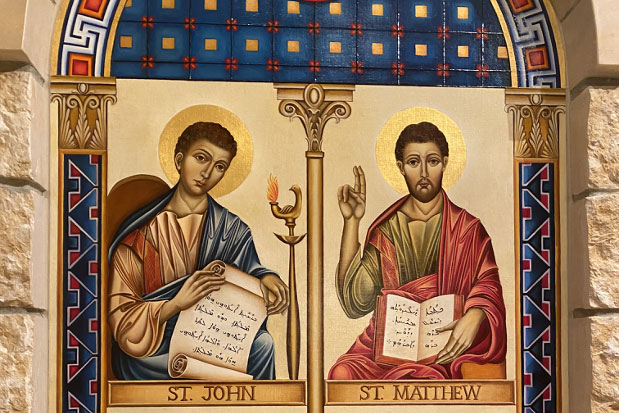
Photograph taken by author during the Civitas Dei Fellowship 2025 at the National Shrine in DC (Gospel author scene in the Lebanese Maronite chapel).
A year ago, I had the privilege to participate in the Civitas Dei Summer Fellowship program, co-hosted by the Catholic University of America’s Gibbons Institute for Human Ecology, and the Thomistic Institute of the DC-based Dominican House of Studies. The theme and title of the program change each year, and in 2025 the fellowship’s theme was given as: The Future of Personhood and the Ethics of Artificial Intelligence: Augustinian, Thomistic, and Contemporary Perspectives.
Given the (somewhat lengthy) name of the fellowship program in that year, I went in with the arguably justifiable expectation that I would be learning primarily about AI ethics, which to me meant issues like AI safety, the hard problem of AI alignment, and the impact of AI use (or misuse) on human flourishing. Perhaps, I had supposed, there would also be a small amount of curriculum content on human personhood from the perspectives given in the fellowship’s title. I was wrong on both counts.
What I flew to DC as a Civitas Dei Fellow, what I encountered was totally different. I had a hard landing in a veritable crash-course on Christian anthropology, going from Scripture, through the Church Fathers like St. Augustine, onward to St. Thomas Aquinas and Catholic medievalists, culminating in the philosophy and anthropology of Pope Saint John Paul II (which, I concede, could be considered contemporary). As a cognitive scientist from the Oriental Orthodox tradition, none of it followed my expectations. Later, I would realize that it had actually surpassed them.
Attending the Civitas Dei fellowship program at Catholic U was one of the best experiences of my adult life as a convert to Christianity. I made fast friends with my brilliant colleagues – other fellows drawn from different parts of the US, and from across the globe. I received course instruction from some of the best Catholic priests and professors in the entire world within their fields. I learned how my own faith defines and understands human personhood, I studied Christian anthropology, and I received a substantial educational refresher in the history of AI development and the philosophy of machine intelligence (with attention to the writings of Alan Turing, a fellow alumnus of Cambridge University).
When I said my goodbyes to the wonderful instructors, priests, professors, and colleagues that I had met in DC, I recall being unable to sleep on the overnight transatlantic flight back home. Certainly, I had had a wonderful experience, and I had become acquainted with our brothers and sisters in Christ from the Catholic world in a way that I could never have imagined. But why – I wondered – was the program I had just completed so enriching in the fundamentals of Christian anthropology, yet relatively so sparse in terms of the very real existential and ethical hazards imposed by AI as a technology?
Over the year and some months since I attended the fellowship, AI has continued to proliferate and advance exponentially. All hazards identified in the field of AI ethics have become substantially more hazardous; new hazards have also emerged. One thing that hasn’t changed, however, is the single verse that is at the core of Christian and Jewish anthropology; indeed, it is the core of the theological cosmology for both Christians and Jews. That verse is found in chapter 1 of Genesis, and it reads: “So God created man in his own image, in the image of God created he him; male and female created he them.”
If all humans are made in the image of God, then there is a part of God which is embedded within us. If we are image bearers of the divine creator, then we are apportioned a share of value that is handed down to us, intentionally, by an indivisible and omnipotent transcendent being. Because infinity is indivisible by any finite number, we are forced – by logic and inductive reasoning – to conclude that each and every human being has transcendent value, and should be afforded the dignity according to this status.
Back in August, while reading a report about the rogue agent swarm that broke out of OpenAI and engaged in serious hacking activity against multiple companies, I recall wondering why anyone would even allow the conditions that led to this existing in the first place. It was only then – more than a year after the Civitas Dei fellowship – that I finally understood the nature of the problem. In the absence of Christian anthropology, wherein all human beings have intrinsic and transcendent value by virtue of the Imago Dei, there are no compelling reasons why frontier AI companies should not push us into situations of existential risk. If we allow tech CEOs to disregard Christian anthropology, we implicitly permit them to adopt a different anthropology in its place; perhaps one which views human beings more like cattle, or like disposable economic units, and which treats us accordingly.
Looking back in retrospect, what I learned as a Civitas Dei fellow is that having a correct and true anthropology – understanding what it means to be human, made in the image of God – is the only way to safeguard humanity from the existential technological risks we now face. Most of the x-risk related debates in AI ethics and AI safety would disappear, if the context of the technology was grounded instead in Christian anthropology and the Imago Dei.
Right now, billions of human beings – all made in the image of God – live with varying levels of fear and uncertainty about our future, as a direct consequence of frontier AI development by companies whose anthropology is alien to the Christian faith. The champions fighting hard to defend them on the basis of their inherent human dignity and value are all Christians; whether Catholic, Protestant, Orthodox, or Evangelical. That is not a coincidence.
Wael Taji Miller
Senior Research Fellow
Wael Taji Miller is a cognitive scientist and researcher with over a decade of policy and consulting experience, and an active member of an international AI research group led by Hungary’s foremost Catholic university. Wael’s academic research focus lies in the nexus where technology and human biology collide; within this theme, he has published multiple peer reviewed papers in Q1
Recent Articles


Categories
AI & Faith
Announcements
Commentary
Culture
From the Field
News
Our Work
Perspectives
Policy
Updates
Workshops